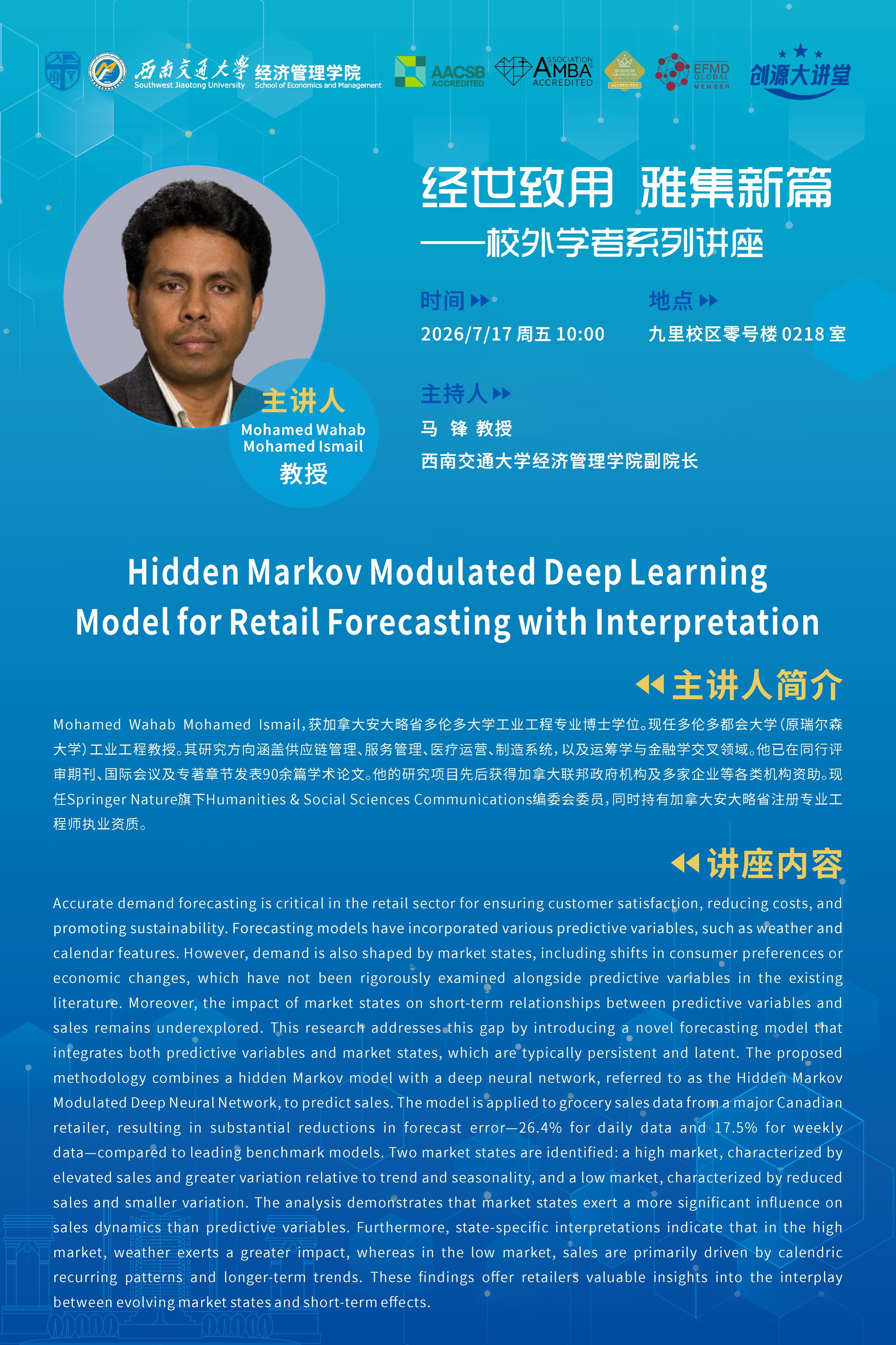
讲座题目:Hidden Markov Modulated Deep Learning Model for Retail Forecasting with Interpretation
主讲人:Mohamed Wahab Mohamed Ismail 教授
讲座时间:2026年7月17日(周五)上午10:00
讲座地点:九里校区零号楼0218室
主讲人简介:Mohamed Wahab Mohamed Ismail,获加拿大安大略省多伦多大学工业工程专业博士学位。现任多伦多都会大学(原瑞尔森大学)工业工程教授。其研究方向涵盖供应链管理、服务管理、医疗运营、制造系统,以及运筹学与金融学交叉领域。他已在同行评审期刊、国际会议及专著章节发表90余篇学术论文。他的研究项目先后获得加拿大联邦政府机构及多家企业等各类机构资助。现任Springer Nature旗下Humanities & Social Sciences Communications编委会委员,同时持有加拿大安大略省注册专业工程师执业资质。
讲座内容:Accurate demand forecasting is critical in the retail sector for ensuring customer satisfaction, reducing costs, and promoting sustainability. Forecasting models have incorporated various predictive variables, such as weather and calendar features. However, demand is also shaped by market states, including shifts in consumer preferences or economic changes, which have not been rigorously examined alongside predictive variables in the existing literature. Moreover, the impact of market states on short-term relationships between predictive variables and sales remains underexplored. This research addresses this gap by introducing a novel forecasting model that integrates both predictive variables and market states, which are typically persistent and latent. The proposed methodology combines a hidden Markov model with a deep neural network, referred to as the Hidden Markov Modulated Deep Neural Network, to predict sales. The model is applied to grocery sales data from a major Canadian retailer, resulting in substantial reductions in forecast error—26.4% for daily data and 17.5% for weekly data—compared to leading benchmark models. Two market states are identified: a high market, characterized by elevated sales and greater variation relative to trend and seasonality, and a low market, characterized by reduced sales and smaller variation. The analysis demonstrates that market states exert a more significant influence on sales dynamics than predictive variables. Furthermore, state-specific interpretations indicate that in the high market, weather exerts a greater impact, whereas in the low market, sales are primarily driven by calendric recurring patterns and longer-term trends. These findings offer retailers valuable insights into the interplay between evolving market states and short-term effects.








 网络理校 | COPYRIGHT © 2021 西南交通大学. ALL RIGHTS RESERVED. 蜀ICP备05026985号-3
 搜索
搜索 川公网安备 51010602000061号